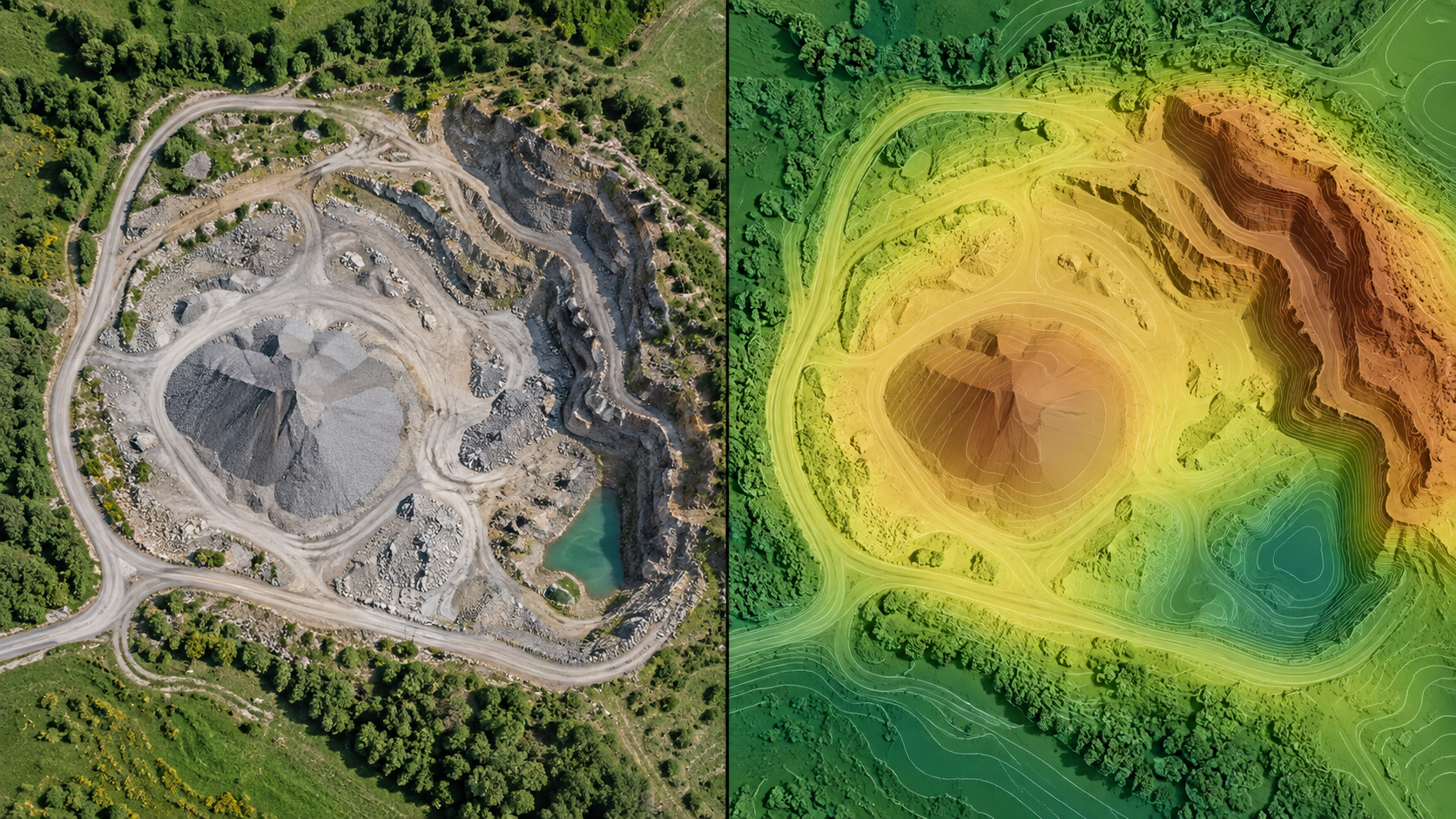
Mining and quarry sites combine steep faces, occlusion, machinery, dust, and changing ground conditions. Those conditions deserve an explicit review sequence.
Inspect the reconstructed surface
Use the orthophoto, DSM or DTM, contours, and point cloud together. Look for holes, edge noise, vegetation, moving equipment, water, and unsupported interpolation.
Define boundary and base
Trace a defensible calculation boundary and choose a surveyed base, prior surface, fitted plane, or boundary interpolation that matches the operational question. Record the method and sign convention.
Test sensitivity
Compare alternate reasonable boundaries where the toe is uncertain. Review cut and fill spatially rather than relying only on the net value.
Deliver context
Preserve the surface revision, units, coordinate and height references, capture date, checkpoint evidence, exclusions, and assumptions. A repeatable volume workflow is more useful than a number without provenance.
Capture for the geometry you need
Stockpiles and benches need visibility at the toe, crest, and steep faces. A nadir-only grid may leave vertical surfaces poorly constrained, while obliques can add useful viewpoints. Plan safe stand-off, consistent lighting where possible, boundary margin, and enough cross coverage to reduce occlusion. Remove neither machinery nor people digitally; instead document moving objects and recapture when operationally practical.
Select a base method explicitly
Use a surveyed base surface when available. A prior survey can support change volume when both epochs share a compatible reference and stable common area. A fitted plane may suit a pile on a known pad; boundary interpolation assumes the perimeter represents the base. Each method answers a different question, so name it in the result.
Review sensitivity
Trace the boundary at a defensible break in slope, inspect the 3D surface, and compare one or more reasonable alternate boundaries. Look at cut and fill separately before relying on net volume. Check holes, water, vegetation, conveyor structures, walls, and edge noise. If a large part of the base is inferred, state that prominently.
Make repeat surveys comparable
Use the same CRS, vertical reference, units, stable control, area of interest, and sign convention. Archive the source surface, base surface, polygon, calculation settings, result table, and screenshots. A volume value without those inputs cannot be independently reproduced or meaningfully compared next month.
Example base-method comparison
A stockpile sits on a partly visible pad beside a retaining wall. Boundary interpolation is tested first, but the wall-side toe is obscured and the perimeter does not describe the underlying pad well. A surveyed pad surface is available, so it becomes the primary base. The boundary-interpolated result is retained as a sensitivity comparison rather than silently averaged.
The reviewer inspects cut and fill maps, cross-sections, holes, equipment, vegetation, and edge noise. The final record states the polygon, DSM revision, base revision, sign convention, cell handling, and both comparison values. If operational movement occurred during the flight, it is noted.
The number is therefore traceable to an explicit geometric assumption. A recipient can understand why it differs from a quick polygon calculation and can repeat it when the next survey arrives.
Sign-off record
Before relying on the workflow, record the project and revision, source dataset, selected preset or method, coordinate and height references, units, processing version, warnings, exclusions, independent validation, and the artifact used for the decision. Reopen critical outputs in an independent viewer and keep their checksums with the report.
The reviewer should answer four questions in writing: Is the required area supported by source evidence? Does the chosen product actually answer the operational question? Are accuracy and limitations stated without inferring more than the checks prove? Can another person reproduce the result from the retained inputs and settings?
If any answer is no, hold the delivery or label the limitation. A documented stop is safer than a polished output whose assumptions cannot be recovered.