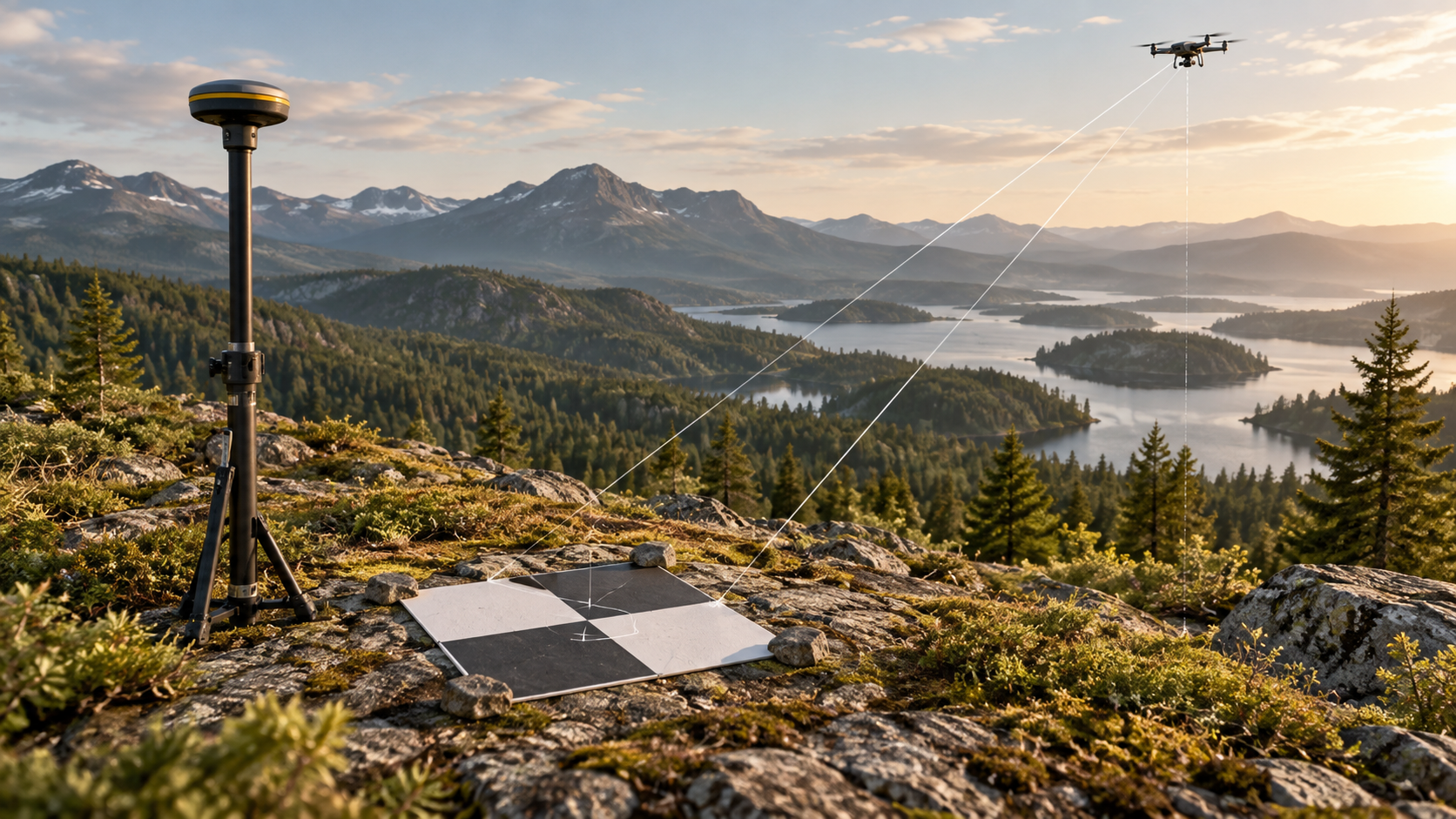
A ground control point connects visible image evidence to an independently surveyed coordinate. A checkpoint is deliberately excluded from fitting and used for validation.
Distribute evidence
Place visible targets around the survey extent and, where practical, across its height range. Mark the target centre consistently in multiple sharp photographs.
Preserve coordinate meaning
Record horizontal CRS, vertical datum, units, antenna or target offsets, point names, and survey method. Swapped axes or mixed height references can create a coherent-looking but displaced output.
Report honestly
Control residuals describe the fitted points. Checkpoint errors provide more independent evidence, but neither proves that every surface cell has the same accuracy. Report point counts, spatial distribution, error statistics, exclusions, and limitations.
If a project has no independent checkpoints, say so directly instead of converting internal reconstruction precision into a survey-accuracy claim.
Design the control network
Place targets around the perimeter, through the interior, and across meaningful height changes. Avoid putting every point on one straight road or at one elevation. The target must be large enough for the planned GSD, high contrast, stable, and visible in several sharp photographs. Survey its centre consistently and record how the coordinate was obtained.
Reserve independent checkpoints before processing. If every surveyed point participates in adjustment, there is no independent test of the fitted model. The ideal count depends on site geometry and risk; spatial distribution matters more than a magic minimum.
Prevent reference-system mistakes
Store the CRS identifier, datum realization when relevant, axis order, linear units, vertical datum, geoid model, epoch where required, and antenna/target offsets. Preview the points on a trusted basemap and compare their height range with the site. A metre/foot mix or ellipsoid/geoid mismatch can look systematic and still be operationally serious.
Review marking and residuals
Inspect every image observation of a control point, reject ambiguous marks with a documented reason, and look for one point whose residual pattern differs from the network. Do not remove an inconvenient checkpoint only to improve the summary statistic.
Report horizontal and vertical checkpoint errors, RMSE or other agreed statistics, point count, distribution, exclusions, survey method, and limitations. Keep the control source, marked observations, processing report, and exported checkpoint table with the project revision.
Example of a plausible but wrong result
A control file in feet imported as metres may still produce a coherent-looking model at an absurd scale. Ellipsoidal image heights combined with orthometric control can create a systematic vertical difference. Swapped axes can move points far away, while a wrong local grid definition may create a smaller but operationally serious shift.
Catch these errors before adjustment by checking bounds, units, known coordinates, height range, and a plotted overlay. After processing, inspect residual direction and magnitude, not only the average. A shared pattern can indicate a reference problem rather than six independent marking mistakes.
The project should retain the original control file, normalized import, transformation record, marked observations, exclusions, and checkpoint table. That evidence allows correction without guessing which values were changed.
Sign-off record
Before relying on the workflow, record the project and revision, source dataset, selected preset or method, coordinate and height references, units, processing version, warnings, exclusions, independent validation, and the artifact used for the decision. Reopen critical outputs in an independent viewer and keep their checksums with the report.
The reviewer should answer four questions in writing: Is the required area supported by source evidence? Does the chosen product actually answer the operational question? Are accuracy and limitations stated without inferring more than the checks prove? Can another person reproduce the result from the retained inputs and settings?
If any answer is no, hold the delivery or label the limitation. A documented stop is safer than a polished output whose assumptions cannot be recovered.