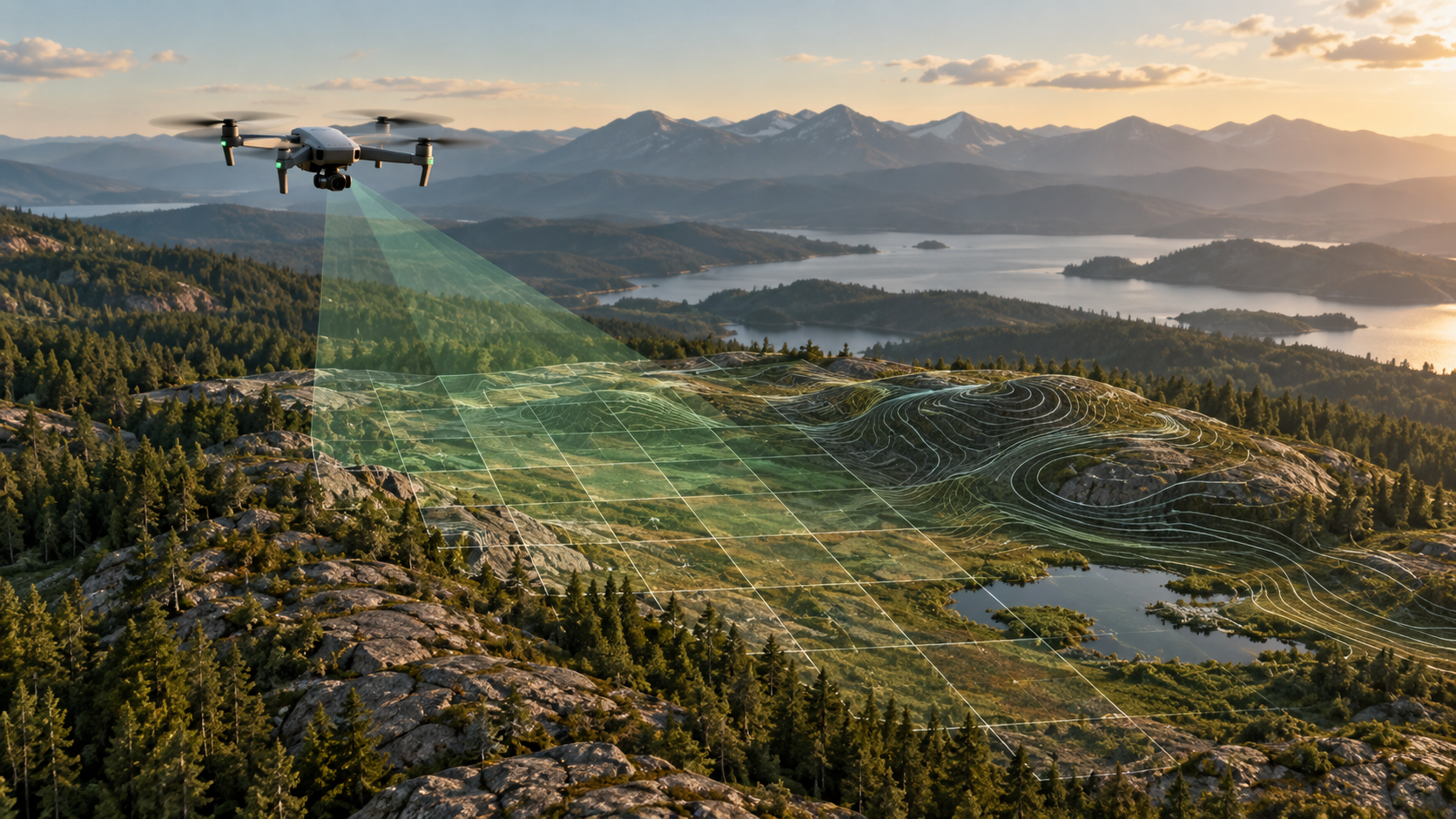
Photogrammetry needs the same ground feature to appear clearly in several photographs. Flight planning determines whether that evidence exists.
Overlap and cross coverage
Forward and side overlap should remain adequate across the whole site, including turns and elevation changes. Cross-grid or oblique imagery can help complex structures, while consistent nadir capture suits flatter mapping work.
Ground sampling distance
GSD links flight height and camera geometry to approximate ground detail. A smaller number is not automatically better: motion blur, noise, storage, processing time, and the required deliverable all matter.
Field checklist
- Set the survey boundary with margin for edge reconstruction.
- Keep exposure and focus consistent.
- Account for wind, shadows, water, reflective surfaces, and moving objects.
- Record coordinate and height references.
- Review a few images at full resolution before leaving.
A clean, coherent flight is faster to process and easier to defend than a larger collection of inconsistent images.
Convert the deliverable into a capture plan
Begin with the required outputs, accuracy evidence, site relief, safety constraints, and coordinate reference. A flat orthophoto mission and a steep quarry-wall model need different viewpoints. Define the survey boundary with enough margin so edge reconstruction falls outside the area of interest, then choose altitude and camera settings that support the required GSD without sacrificing sharpness.
Account for terrain and light
Ground-relative overlap decreases when terrain rises toward a fixed-altitude aircraft. Use terrain following where it is safe and supported, or add flight lines and oblique coverage. Low sun creates long moving shadows; midday can create glare and weak texture. Wind increases motion blur and changes vegetation. Water, glass, repetitive roofs, sand, and uniform crops can remain difficult even with more images.
Keep capture consistent
Lock focus after verification, avoid unnecessary digital zoom, use a shutter speed suitable for aircraft motion, and monitor exposure rather than relying on a single test frame. Multi-battery missions should preserve altitude, overlap, camera orientation, and time continuity. Record interruptions and repeat questionable strips while still on site.
Field acceptance before leaving
Check image count, storage integrity, several full-resolution frames from each battery, sharpness at centre and corners, histogram clipping, camera positions, boundary coverage, and control visibility. Keep original files and flight logs. A ten-minute field review is usually cheaper than a return visit or an attempt to tune around missing evidence.
Example plan adjustment
A flat open field may be covered by a consistent nadir grid with boundary margin and suitable forward/side overlap. A quarry with benches and steep faces needs additional viewpoints, safe stand-off, height-aware coverage, and control distributed through its relief. Reusing the flat-field plan would leave important faces weak or unseen.
During the field review, plot camera positions and inspect full-resolution frames from the beginning, middle, and end of every battery. If wind has blurred one strip or a battery change created a seam with weak overlap, repeat it while access and permissions are still active.
Keep the planned and actual flight records. The difference between them often explains later gaps, and it gives the next visit a concrete improvement rather than a vague instruction to “take more photos.”
Sign-off record
Before relying on the workflow, record the project and revision, source dataset, selected preset or method, coordinate and height references, units, processing version, warnings, exclusions, independent validation, and the artifact used for the decision. Reopen critical outputs in an independent viewer and keep their checksums with the report.
The reviewer should answer four questions in writing: Is the required area supported by source evidence? Does the chosen product actually answer the operational question? Are accuracy and limitations stated without inferring more than the checks prove? Can another person reproduce the result from the retained inputs and settings?
If any answer is no, hold the delivery or label the limitation. A documented stop is safer than a polished output whose assumptions cannot be recovered.